Seasonal Work and the Shape of a Working Day
Seasonal work and the shape of a working day can balance field conditions with fixed commitments, helping crews plan tasks, breaks and clear handovers.
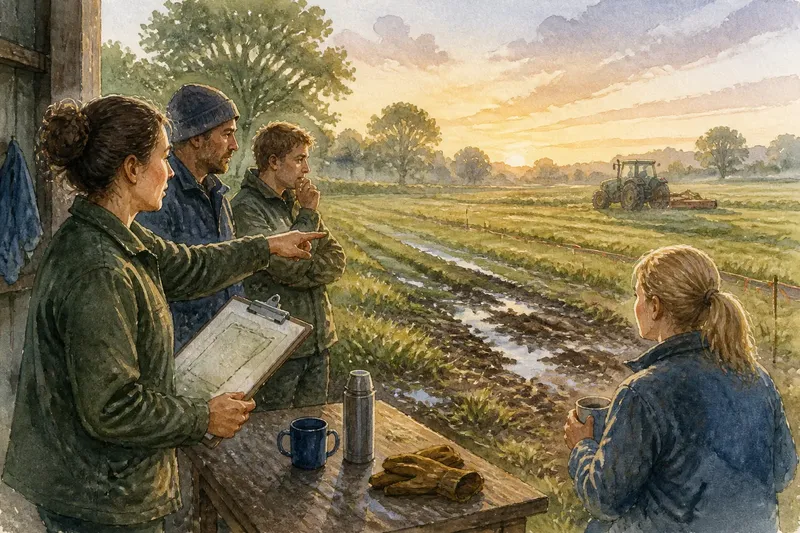
At dawn, a field crew reaches a wet meadow to cut hay, but the mower cannot enter without leaving deep ruts. The team has arrived on time; the work itself is not ready. Seasonal work and the shape of a working day depend on this distinction: some jobs are organised around a task reaching completion, while others need people at a set hour, whatever the weather.
Neither rhythm is automatically better. A task-led day follows the work’s condition and sequence; a clock-led day protects agreed times, attendance and handovers. Rural jobs often combine both. The useful question is which arrangement keeps the work coherent and fair to the people doing it.
A wet meadow makes the choice visible
Imagine a hypothetical haymaking crew on a small farm. The owner, Ruth, has arranged for three seasonal workers to cut and turn a meadow, then help load bales when the crop is ready. Overnight rain has softened the ground. A contractor is due later in the week, and one worker must catch a bus home at an agreed time.
Ruth could set a clock-led plan: start at the usual hour, mow the first field, and break at the scheduled time. That gives everyone a clear reporting time and makes transport and meals easier to arrange. But if the ground is too soft, pressing ahead could damage the surface and waste the crew’s effort. A timetable can organise attendance; it cannot make a field ready.
She could instead make the day task-led: inspect the meadow, wait until the surface bears the tractor, then cut until the planned section is complete. That fits the crop and ground more closely, but an open-ended day can leave workers uncertain about when they will finish. It can also conflict with a bus timetable or a promised handover.
The practical answer is a mixed arrangement. Ruth sets a firm start and a check-in time, then makes the next decision after inspecting the meadow. If it is still too wet, the crew moves to a suitable indoor task. If conditions allow mowing, the team works through a clearly marked section, with a defined stopping point and a fresh check before continuing.
Task-led work follows dependencies
A task-led day is organised by what must happen next. In haymaking, cutting usually has to precede turning, and drying has to precede baling. The order matters because each task changes the material the next person receives. Similar dependencies appear in lambing support, fruit picking, drainage maintenance and seasonal packing: work may be judged by a completed row, flock check or batch rather than by time on site.
This rhythm can help teams respond to changing conditions. A worker may finish a boundary before moving equipment, or continue a harvest while the crop is in good condition. The work has a visible endpoint, which can make responsibilities easier to understand. Yet “finish the task” needs a shared meaning. A row might be cut but not cleared; a load might be ready but not secured for collection.
Task-led work also has a hidden clock. Daylight, crop condition, animal needs, machinery availability and transport all constrain the task. If the day expands whenever something remains unfinished, workers may absorb the cost through missed connections, late meals or fatigue. A task boundary should therefore include a sensible stopping rule, not merely a target.
For Ruth’s crew, the stopping rule is the marked meadow section, not “all the hay we can manage”. That gives the team a result to aim for while leaving room to stop if the surface softens or the weather changes. Ruth can explain what counts as complete before anyone begins.
Clock-led work protects shared commitments
A clock-led day gives work a set pattern: people arrive, take breaks, meet a vehicle or hand over a task at agreed times. This suits jobs that depend on others being present together. A packing shed may need a crew ready when produce arrives; a livestock shift may require a clear changeover; a delivery route may have customers expecting a known window.
Fixed times can make seasonal work more predictable for workers with childcare, buses or other jobs. They can also prevent one person’s flexible schedule from becoming everyone else’s late finish. The clock is especially useful where a task passes between people: the outgoing worker needs time to explain what is done, what remains and what condition requires attention.
But clock-led work can become misleading if attendance is treated as progress. A crew can be present while machinery waits for a part or a field remains unsuitable. In those moments, a good plan names an alternative task, a decision point or a pause, rather than pretending the original schedule still fits. Otherwise, timekeeping may look orderly while effort is spent on work that cannot sensibly proceed.
Ruth’s fixed check-in gives the crew a shared point to discuss conditions and transport. It does not require them to mow by the clock if the ground is unfit. The arrangement separates what the clock can settle—when people meet and when a decision is made—from what the field must settle: whether cutting can begin.
Set a task boundary and a time boundary
In the hypothetical meadow, Ruth writes the plan on a board in the shed: meet at the agreed start, inspect the ground together, and choose between mowing a marked section or preparing equipment under cover. The crew takes a break at the arranged time. They stop at the section boundary or earlier if conditions change, then record what is finished and what the next crew should know.
The expected observable result is not a promised amount of hay. It is a day in which everyone knows the decision point, the fallback task, the stopping condition and the handover. The worker with the bus can say when they need to leave; Ruth can decide whether the remaining work belongs to the current team or a later shift.
This arrangement resembles a kitchen timer beside a chopping board: the timer helps coordinate a shared moment, while the board shows what remains to be prepared. Neither replaces the other. For seasonal work, the equivalent is a clock for attendance and communication, paired with a visible task boundary that reflects the actual job.
Before setting the day’s plan, Ruth checks each point and decides what to do based on what she observes:
- Ground condition: Check whether the field surface can bear the machinery. If it holds firm under inspection, then consider mowing the marked section; if it is soft, then keep machinery off it and use a suitable alternative task or pause.
- Task endpoint: Check whether the section has clear boundaries and a stated finish condition. If workers can identify both, then assign that section; if not, then mark the boundary and clarify what “finished” means before starting.
- Fixed commitments: Check the crew’s bus, break and handover times. If the task fits around them, then set work and stopping times accordingly; if it does not, then reduce the section or schedule the remainder for another shift.
- Fallback work: Check whether a useful alternative is available under cover. If suitable work is ready, then name it as the weather-delay task; if not, then agree how the crew will pause and receive an update rather than leaving people to guess.
- Decision authority: Check who can call a pause or change of task and how that person can be reached. If the decision-maker is available, then confirm the contact method; if not, then name an available substitute before the crew splits up.
- Handover details: Check what the next crew needs to know about completed work, unfinished areas and equipment. If those details are clear, then record them on the shed board; if any remain uncertain, then mark them for inspection rather than presenting them as settled.
Say Ruth finds the ground soft, has an indoor equipment-preparation task ready, and knows the worker’s bus departure is fixed. She records the meadow section as not ready, assigns the crew to prepare the mower under cover, and keeps the agreed break and departure times. At the next check-in, the crew inspects the ground again; if it can bear the tractor, they mow the marked section, and if it remains soft, they leave it for a later shift. The resulting decision is clear without treating the original plan as a promise to work unsuitable ground.
The appropriate arrangement depends on the job and the terms people have agreed. Where rules, equipment instructions or local requirements apply, workers and supervisors should check the relevant guidance rather than relying on a general timetable.
Seasonal work benefits from clear handovers
Seasonal crews may not work together for long, and a task can move across shifts or between a farm, contractor and collection team. A short handover can preserve details that a simple “done” cannot: which strip was cut, where equipment was left, whether a load is ready, or why a section was left untouched. A note on a shed board or a direct conversation can be enough if it identifies the next action clearly.
In the meadow situation, Ruth’s record separates completed work from work that is merely delayed. The next crew can see that a section remains uncut because the ground was soft, not because someone overlooked it. This makes the task boundary useful beyond the end of the shift: it carries the reason for the decision forward.
A handover should not conceal uncertainty. If the next step depends on a fresh inspection, say so. If a worker cannot safely confirm whether machinery is ready, leave that question for the person responsible rather than implying certainty. A concise, honest note helps the next person make a sound decision without repeating the earlier inspection blindly.
How should a seasonal crew balance tasks and fixed times?
Is task-led work the same as being paid by the task?
No. Task-led describes how the day is organised, not how someone is paid. Pay arrangements and working terms should be clear separately, so a flexible stopping point does not become an unspoken expectation to work without limit.
When does a clock-led day suit seasonal work?
It often suits shared shifts, collection windows, deliveries and work that needs a reliable handover. It is less useful as a reason to continue a task when conditions make that task unsuitable.
How can a crew plan around uncertain weather?
Set a meeting or decision time, name the condition that permits the main task, and agree on an alternative or a pause. The plan then gives workers something firm to organise around without pretending the forecast controls the field.
What should a seasonal handover include?
State what is complete, what remains, why work stopped or changed, and what the next person should check. Include who can make the next decision if the situation is still uncertain.
Choose the rhythm that serves the work and the people
For seasonal work, a clock can make a day fairer and easier to coordinate, while a task can give it a meaningful finish. The meadow crew’s plan works because neither is asked to do the other’s job: fixed times protect meetings and commitments; the field’s condition governs whether mowing proceeds. A useful working day makes both limits visible.
When planning seasonal work and the shape of a working day, begin with the task’s dependencies, then mark the times people need to rely on. Define what finished means, what can interrupt the plan and how the next worker will know what happened. That gives each job room for its own rhythm without leaving the people doing it to guess where the day ends.