The Millpond Before the Modern Reservoir
Compare a millpond and a reservoir by tracing their outlets, channels and users to understand how each stored and directed water for different purposes.
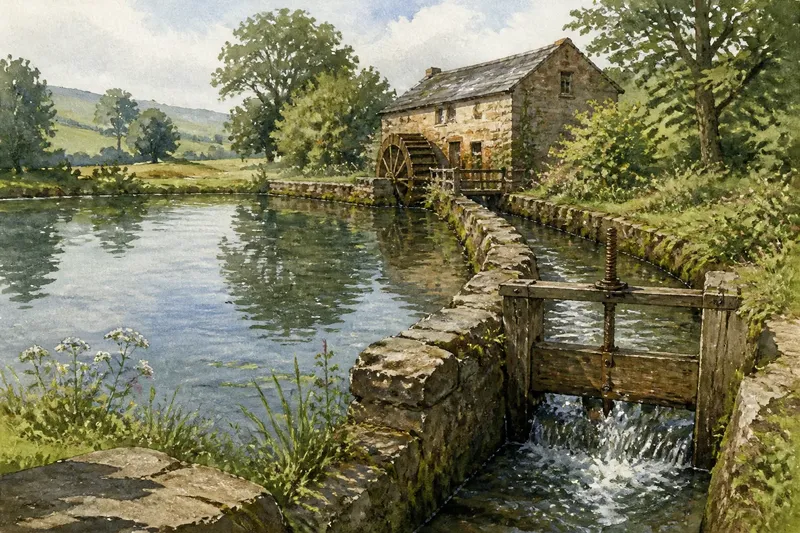
A still pond beside an old millrace can seem like a small reservoir, but the channel leading away may tell a different story. A millpond before the modern reservoir usually stored water for work at a nearby mill; the terms describe different purposes, not a simple historical sequence in which one design replaced the other.
A millpond stored water for the mill’s working rhythm
A watermill needed moving water to turn its wheel. A stream could run strongly after rain and weaken in dry weather, while milling followed the needs of local farms, households or trades. A pond let the miller hold water and release it through a sluice or millrace when the machinery was ready to work.
The pond was not simply a small reservoir. Its function was closely tied to the mill: water entered from a stream, was directed towards the wheel, then continued downstream. The pond helped manage the timing of flow, rather than necessarily supplying a distant settlement or a wider network.
Millponds varied. Some were formed by a bank across a stream; others were fed by a channel diverting water from the main course. A sluice or weir could regulate the flow. Local slope, stream conditions and machinery shaped each arrangement, so “millpond” describes a role rather than one standard design.
Reservoirs could serve purposes beyond one mill
Reservoirs have been built for varied purposes, including water supply, irrigation, industry and flow management. Some were connected to distribution systems serving users beyond the site; others had a more local function. Their purposes and arrangements differ by place and period, so a broad claim about every reservoir would be misleading.
That variation matters when comparing design. A reservoir might be intended to hold water for use across changing seasons, while a millpond was shaped more directly by the flow and water level needed at a particular wheel. “Head” means the vertical difference that gives water force. For a mill, the relationship between pond level, channel and wheel mattered as much as the visible area of water.
A reservoir serving several users could involve decisions about land, supply and how water moved through a wider system. A millpond could also affect neighbours and downstream users, but its central purpose was generally connected to the mill’s operation. Neither label, on its own, explains every effect or later change in use.
Purpose is clearer than size or appearance
A broad pool is not automatically a reservoir, and a small impoundment is not automatically a millpond. To interpret a site, begin with its outlets and the route water takes. A millrace running towards a wheel supports a mill-related reading; a channel or pipe carrying water elsewhere may point to another purpose. One structure may have served several functions, either at the same time or in different periods.
Think of the pond as a bucket placed between a tap and the task it serves: its role depends not just on how much it holds, but on where its outlet leads. In a water landscape, that means looking for the connection between the store, its users and the machinery or network downstream.
What clues distinguish a millpond from a reservoir?
What is the main difference between a millpond and a reservoir?
A millpond primarily stored water to operate a nearby mill, often through a millrace or sluice. A reservoir could serve broader supply or management purposes, though some reservoirs had local uses and some waterbodies changed function over time.
Did a millpond hold water throughout the year?
Not necessarily: its level and usefulness depended on inflow, operation and local water management. A pond might hold water between periods of milling without being designed as a year-round general supply.
Could a millpond later serve as a reservoir?
A waterbody’s purpose could change as local needs and infrastructure changed. New outlets, distribution channels or evidence of a different operating arrangement may support that interpretation, but present-day appearance alone cannot establish when or why the use changed.
Which landscape features should I look for?
Look for a mill building or wheel site, a narrow millrace, a sluice and a bank aligned with a stream. Pipes or channels leading towards other users may suggest a different or additional purpose; local maps, records or heritage advice can help resolve uncertain evidence.
Follow the water to identify the site’s role
For a particular site, trace the water’s destination and ask who or what it served. Water directed to a wheel for nearby work supports the term “millpond”. Water held or directed as part of a broader supply or management arrangement may be better described as a reservoir, depending on the evidence.
- Check for a wheel site: If a wheel or mill building stands beside the outlet, investigate a millpond interpretation; if not, look for other evidence before choosing that label.
- Check the outlet’s direction: If a narrow channel leads towards mill machinery, follow it as a possible millrace; if it leads elsewhere, trace that route before deciding the pond’s purpose.
- Check for a sluice or weir: If a control structure directs water towards a wheel, consider a mill-related function; if it controls another outlet, identify where that outlet goes.
- Check for pipes or distribution channels: If they connect the pond to other users, consider a broader supply role; if no such route is visible, avoid assuming one and seek additional evidence.
- Check maps and local records: If a map or record identifies a mill, race or supply route, use that as supporting evidence; if records are unclear or conflict, keep the interpretation provisional.
- Check for signs of altered use: If an outlet or channel appears to have been added or repurposed, consider that the site may have had more than one function; if its history cannot be established, distinguish the visible evidence from an uncertain date or explanation.
Say you find an old pond beside a stream, a low bank and a channel leading towards a ruined mill. In this invented situation, you trace the channel on a local map and see that it ends at the mill rather than continuing towards homes or fields; you also spot a sluice beside the channel. Those clues support describing the pond as a working millpond. If a separate outlet instead appears to feed a supply route, the more careful answer is that the site may have had an additional or later reservoir function, pending confirmation from records.
The millpond before the modern reservoir is best understood by tracing what happened to its water, rather than judging the pool by size. A millrace, sluice or distant outlet can reveal the working relationship hidden by a quiet surface; where evidence is incomplete, describing what is visible and leaving the wider interpretation open is the sounder choice.